
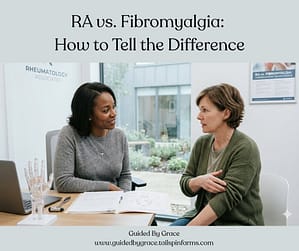
Disclaimer: I am not a doctor, and the information in this post is not intended as medical advice. This guide is for educational purposes only. Always consult a qualified healthcare professional, like a rheumatologist, for an accurate diagnosis and treatment plan for your specific symptoms.
Living with chronic pain and exhaustion is overwhelming. When you are searching for answers, Rheumatoid Arthritis (RA) and Fibromyalgia are two names you will see constantly.
Both conditions cause widespread pain and drain your energy. However, they are completely different illnesses. Learning the differences can help you better explain your symptoms to your doctor and get the right treatment.
What Is Happening Inside Your Body?
The biggest difference between RA and Fibromyalgia is the root cause of the pain.
- Rheumatoid Arthritis (RA) is an autoimmune disease. Your immune system gets confused and attacks the healthy lining of your joints. This causes physical, visible inflammation and can lead to permanent joint damage if left untreated.
- Fibromyalgia is a central pain disorder. It acts like a glitch in your nervous system. Your joints and muscles are not damaged, but your brain and spinal cord amplify normal sensations. Essentially, your brain turns the “volume knob” of pain all the way up.
5 Ways to Spot the Difference
Paying close attention to how your body feels at different times of the day can help you pinpoint what is going on.
1. Look at Your Joints
- With RA: Your joints will look visibly swollen, feel hot to the touch, and may look red. It usually hits the same joints on both sides of your body (like both wrists).
- With Fibromyalgia: Your pain lives in the muscles, soft tissues, and feels like a deep bone ache. Your joints will not look swollen or red.
2. Time Your Morning Stiffness
- With RA: You will feel incredibly stiff when you wake up. This stiffness is severe and usually lasts for hours as you try to move around.
- With Fibromyalgia: You will still feel stiff in the morning, but it usually starts to wear off in less than an hour.
3. Track Your Sensitivity to Touch
- With RA: Pressing on a joint hurts because the tissue inside is actively inflamed.
- With Fibromyalgia: Your skin and muscles feel incredibly tender to even a gentle touch. Gentle pressure on specific areas—like your neck, shoulders, and lower back—can trigger intense pain.
4. Check Your Sleep and “Brain Fog”
- With RA: You feel exhausted because your immune system is constantly working overtime to fight inflammation.
- With Fibromyalgia: The fatigue is often paired with poor sleep, restless legs, and severe cognitive issues. This is often called “fibro fog,” which makes it hard to focus, remember words, or think clearly.
5. Ask About Lab Tests
- With RA: Doctors can see clear evidence on medical tests. Blood tests (looking for Rheumatoid Factor or anti-CCP) and X-rays will show the inflammation and joint damage.
- With Fibromyalgia: There is no blood test or scan that can detect it. Doctors diagnose it by listening to your medical history and ruling out other diseases.
How Treatments Differ (Why Accuracy Matters)
Because RA and Fibromyalgia are caused by entirely different mechanisms in the body, treating them requires completely different medical approaches. Treating RA will not stop Fibromyalgia pain, and Fibromyalgia treatments will not prevent the joint damage caused by RA.
Rheumatoid Arthritis Treatment: Quieting the Immune System
The goal of RA treatment is to calm your overactive immune system, stop inflammation, and protect your joints from permanent physical destruction.
- Disease-Modifying Antirheumatic Drugs (DMARDs): Medications like methotrexate work to slow down the progression of the disease.
- Biologics: Advanced, targeted therapies that block specific proteins in the immune system triggering the inflammation.
- Corticosteroids: Temporary medications used to quickly reduce severe swelling and pain during a major symptom flare-up.
Fibromyalgia Treatment: Calming the Nervous System
Because Fibromyalgia does not cause physical inflammation or tissue damage, its treatment focuses on calming down a hyper-reactive nervous system and improving sleep.
- Nerve Pain Medications & Antidepressants: Medications like duloxetine (Cymbalta), milnacipran (Savella), or pregabalin (Lyrica) are used because they alter the brain chemistry responsible for processing pain signals.
- Low-Impact Exercise: Activities like swimming, walking, and yoga are highly encouraged to build stamina and naturally reduce pain signals over time.
- Cognitive Behavioral Therapy (CBT): Therapy helps patients develop behavioral coping mechanisms to manage the psychological toll of chronic nervous system pain.
What to Expect: Your First Rheumatologist Visit
Walking into a specialist’s office can feel intimidating, but knowing what to expect can help ease your anxiety. Your first appointment with a rheumatologist will typically last 45 to 60 minutes and focuses on gathering clues.
- Deep-Dive Medical History: Your doctor will interview you extensively about your symptoms. They will want to know exactly when your pain started, what makes it better or worse, and how long your morning stiffness lasts.
- The Physical Exam: The doctor will physically examine your joints, checking for visible swelling, warmth, redness, and range of motion. If they suspect Fibromyalgia, they will gently test specific sensitive areas across your body for tenderness.
- Diagnostic Orders: You will likely be sent for blood work to check for inflammation markers and autoimmune antibodies. The doctor may also order imaging studies like X-rays or ultrasounds to look for hidden joint damage.
Patient Tip: Because rheumatologists rely heavily on your story, bring a written symptom log tracking your daily pain levels and morning stiffness timing to make the most of your visit.
Questions to Ask Your Rheumatologist
Appointments go quickly, and it is easy to forget what you wanted to say. Write down or print out these targeted questions to bring to your first visit:
- Based on my physical exam, do you see signs of active joint inflammation or is it mostly muscle tenderness?
- Which specific blood tests and imaging scans are we running, and what exactly are we looking for?
- Is it possible that my symptoms are being caused by a combination of both RA and Fibromyalgia?
- How long do you expect it will take to get these test results back and confirm a diagnosis?
- While we wait for the final test results, what can I do safely at home right now to manage this pain?
What You Should Do Next
It is entirely possible—and unfortunately common—for a patient to have both conditions at the exact same time. Because the treatments for RA and Fibromyalgia are completely different, getting an accurate diagnosis from a professional is crucial.
If you are struggling to manage your pain, it is time to see an expert. You can use the official American College of Rheumatology directory to find a licensed specialist near you who can help you take control of your health.
Bible Study Tools I Use
- NIV Bible
- King James Bible
- www. biblegateway.com
- www.biblestudytools.com
- Map Pencils
- Strong’s Concordance
- College Ruled Spiral Notebook
- Ballpoint Pens
- Some links may be affiliated. By purchasing an item from an affiliate link, I receive a small commission – but you are not charged more or less by clicking or purchasing through the link. Thank you for supporting me!
Some of our Post That Might Interest You, All Out of the Current Book / Chapter
- Is It RA or Fibromyalgia? A Patents Guide to Telling Them Apart
- Finding Strength on My Journey with RA
- Living With Fibromyalgia: A Journey of Strength, Faith, and Perseverance
- Following Jesus in a Distracted World
- THANK GOD IT’S FRIDAY: A FRESH START WRAPPED IN GRACE
- GOOD MORNING BEAUTIFUL SOUL
- HOW TO BEGIN READING THE BIBLE USING THE S.O.A.P. BIBLE STUDY METHOD
- WORD OF THE YEAR INSTEAD OF A RESOLUTION
- GOD IS SO GOOD – ALL THE TIME!
- Guided By Grace About
Thanks for stopping by the blog today! I love having you here. If this post resonated with you, please drop a comment below and share your thoughts. See you in the next post!

One Reply to “Is It RA or Fibromyalgia? A Patient’s Guide to Telling Them Apart”
Comments are closed.