START YOUR DAY RIGHT DAILY DEVOTION
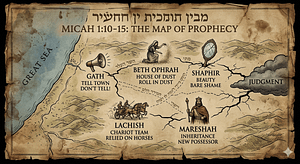
(KJV) Micah 1:10-15
Declare ye it not at Gath, weep ye not at all: in the house of Aphrah roll thyself in the dust. 11 Pass ye away, thou inhabitant of Saphir, having thy shame naked: the inhabitant of Zaanan came not forth in the mourning of Bethezel; he shall receive of you his standing. 12 For the inhabitant of Maroth waited carefully for good: but evil came down from the Lord unto the gate of Jerusalem. 13 O thou inhabitant of Lachish, bind the chariot to the swift beast: she is the beginning of the sin to the daughter of Zion: for the transgressions of Israel were found in thee. 14 Therefore shalt thou give presents to Moreshethgath: the houses of Achzib shall be a lie to the kings of Israel. 15 Yet will I bring an heir unto thee, O inhabitant of Mareshah: he shall come unto Adullam the glory of Israel.
GATH … BETH OPHRAH / MICAH 1:10-15
The Divine Wordplay: Unpacking the “Pun-ishment” in Micah 1:10-15
When we skim through the Old Testament, geographic lists can often feel like dry, ancient directories. However, in Micah 1:10-15, the prophet Micah unleashes a brilliant, heart-wrenching literary masterpiece. Writing to the Southern Kingdom of Judah, Micah uses a rapid-fire series of Hebrew puns—known as paronomasia—to show that a town’s very name, reputation, or identity would become the instrument of its downfall.
By substituting the literal names of these towns with their linguistic definitions or phonetic counterparts, Micah exposes the raw grief of a nation whose hollow foundations are collapsing under judgment.
The Geography of Grief: The Puns Explained
Micah’s hometown region of the Shephelah—the Judean foothills—bears the brunt of this poetic oracle. Translated closer to its original Hebrew wordplay, the text transforms from a map into a vivid portrait of poetic justice.
+-------------------+--------------------+-------------------------------------------+

| Biblical Town     | Literal / Sounds-  | Micah's Wordplay / Prophetic Destiny      |
|                   | Like Meaning       |                                           |
+-------------------+--------------------+-------------------------------------------+

| Gath (v. 10)      | "Tell-Town"        | Do not "tell" it in Tell-Town.            |
|                   |                    |                                           |
| Beth Ophrah       | "House of Dust"    | Roll in the dust in Dust-Town.            |
| (v. 10)           |                    |                                           |
| Shaphir (v. 11)   | "Beauty / Fair"    | The beautiful town is exposed in naked    |
|                   |                    | shame.                                    |
| Zaanan (v. 11)    | "Going Forth"      | The marching town will not come out to    |
|                   |                    | fight.                                    |
| Beth Ezel         | "House of Roots /  | The well-rooted town loses its standing   |
| (v. 11)           | Foundation"        | place.                                    |
| Maroth (v. 12)    | "Bitterness"       | Longing for sweetness, they taste only   |
|                   |                    | bitterness.                               |
| Lachish (v. 13)   | Sounds like "Team  | Harness fast horses to flee; your military |
|                   | of Chariots"       | reliance was your sin.                    |
| Moresheth Gath    | "Betrothed /       | You will give parting dowry gifts to the  |
| (v. 14)           | Bride"             | invading husband (conqueror).            |
| Achzib (v. 14)    | "Deception /       | Deceit-Ville will prove to be a complete  |
|                   | False Spring"      | illusion to Israel's kings.               |
| Mareshah (v. 15)  | "Possession /      | A new conqueror (heir) will take          |
|                   | Inheritance"       | possession of Possession-Town.            |
+-------------------+--------------------+-------------------------------------------+
Why the Wordplay Matters
This was far more than a display of clever rhetoric. In the ancient Near East, a name was inextricably linked to identity, character, and destiny. By targeting these specific towns, Micah delivers three enduring spiritual truths:
- Shattered False Security: The towns trusted in their natural advantages—Shaphir in its beauty, Zaanan in its military egress, and Lachish in its formidable chariots. God demonstrates that the earthly attributes we rely upon can vanish in a moment when we omit Him from our lives.
- The Irony of Sin: The puns mimic the exact nature of our compromise. Achzib (“Deception”) promised economic and defensive prosperity but left the kings empty-handed. Sin always fails to deliver on its promises, turning our pride into the very landscape of our poverty.
- A Heart of Grief, Not Glee: Micah is not mocking these communities; he is weeping. In Micah 1:8-9, he states he is wailing like a jackal. Because Micah’s own hometown of Moresheth is included in the devastation, he is sharing completely in the grief of the community.
Living Beyond the Puns Today
We may not live in the Judean foothills, but we often inhabit our own modern equivalents of these ancient towns. We build our lives in our own “Shaphir,” trusting in outward appearances, or “Lachish,” leaning on our professional and financial mechanics.
Micah’s ancient wordplay challenges us to examine where our true identity rests. When our security is rooted exclusively in the Lord, our foundations will hold firm, no matter how much the dust of this world settles around us.
Closing Prayer
Lord God, You are the Alpha and the Omega, the author of our lives, and the one who calls us by name. Forgive us for the times we have built our identities on the shifting sands of our own accomplishments, beauty, or strength. Search our hearts today, Lord. Deliver us from the deceptiveness of our own ‘Achzibs’ and the false security of our own ‘Lachishes.’ When the trials of life shake our world, remind us that our true citizenship is not found in perishable cities, but in Your eternal Kingdom. Strip away our pride, and anchor our souls in Your unchanging grace. We ask these things in the holy name of Jesus, Amen.
Bible Study Tools I Use
- NIV Bible
- King James Bible
- www. biblegateway.com
- www.biblestudytools.com
- Map Pencils
- Strong’s Concordance
- College Ruled Spiral Notebook
- Ballpoint Pens
- Some links may be affiliated. By purchasing an item from an affiliate link, I receive a small commission – but you are not charged more or less by clicking or purchasing through the link. Thank you for supporting me!
Some of our Post That Might Interest You, All Out of the Current Book / Chapter
- IT HAS COME TO JUDAH / MICAH 1:9
- I WILL WEEP AND WAIL / MICAH 1:8-9
- SAMERIA A HEAP OF RUBBLE / MICAH 1:6
- TRANSGRESSION … SINS / MICAH 1:5
- MICAH – SAMARIA AND JERUSALEM / MICAH 1:1
- GUIDED BY GRACE HOME
Thanks for stopping by the blog today! I love having you here. If this post resonated with you, please drop a comment below and share your thoughts. See you in the next post!
6 Replies to “GATH … BETH OPHRAH / MICAH 1:10-15”
Comments are closed.