I'm Margaret (AKA "Margarita"). I am a Christian, wife, mother of three, and grandmother (AKA "Mimi") of three.
My husband Stace and I met many, many years ago. We have had our share of up and downs but I'm forever grateful that he is the man God blessed me with. I am happy to report we have been married for 25 years.
I love this space on the internet. I create blog posts about faith, my Christian Walk, and our life on the farm. I have learned from the Word of the Lord. I hope this space will give you encouragement and inspiration in your walk with God.
I speak on topics that make some breathe a sigh of relief and make others get pretty uncomfortable. I believe that there is power in transparency and that as children of God, we shouldn't hold anything back. Yes, even those raw and messy parts of our Life's Journey.
Over the last several years, I have wrestled with my purpose, struggled with various sins, survived some severe injuries, and was diagnosed with severe illnesses that have stopped me in my tracks. Although these dark times have been tough, my walk with God and family has proven to be so fulfilling and sweet, regardless of any earthly circumstance. Christ is enough! And I want you to see that He is enough for you too.
The Lord has put it on my heart to share His Word with you.
I'm truly honored to meet you and hope you'll introduce yourself to me as well.
(KJV) Romans 8:16 The Spirit itself beareth witness with our spirit, that we are the children of God:
THE SPIRIT HIMSELF TESTIFIES / ROMANS 8:16
As we follow the guidance of the Holy Spirit and remain in right relationship with Jesus, the Spirit gives us the confidence that we are God’s children (Romans 8:15). He makes us aware that Jesus continues to love us and that He is our constant mediator in heaven (Hebrews 7:25). The Spirit also shows us that God the Father loves us as His adopted children no less than He loves His one and only Son, Jesus (John 14:21, 23; 17:23); and He reminds us of the reward Jesus will share with us in heaven. Finally, the Spirit creates in us the love and confidence by which we cry to Him, “Abba, Father” (Romans 8:15) – which is an expression of a deeply personal relationship with and access to God.
Some links may be affiliated. By purchasing an item from an affiliate link, I receive a small commission – but you are not charged more or less by clicking or purchasing through the link. Thank you for supporting me!
Some of our Post That Might Interest You, All Out of the Current Book / Chapter
Thank you for taking the time to read my Daily Devotion.
Acts 1:8 But ye shall receive power, after that the Holy Ghost is come upon you: and ye shall be witnesses unto me both in Jerusalem, and in all Judaea, and in Samaria, and unto the uttermost part of the earth.
YOU WILL RECEIVE POWER / ACTS 1:8
This is the key verse in the book of Acts. The primary purpose of the baptism in the Spirit is to provide power to communicate the message of Jesus to others. The purpose of the baptism is to receive power to deliver the message that those who do not have a personal relationship with God can receive His forgiveness, learn to follow Jesus and fulfill His purposes for their lives. The end result is that more people come to know, love and honor Jesus as Lord – the Leader and authority in their lives (Matthew 28:18-20; Luke 24:49; John 5:23; 15:26-27).
“Power” (Greek dunamis) means more than strength or ability; it refers to a power at work or in action. Luke (in his Gospel and in Acts) points out that the Holy Spirit’s power included the authority to drive out evil spirits (to command them to release their control in people’s lives) and the anointing (empowering, commissioning) to heal the sick. These were described as the two essential signs accompanying the bold message of God’s kingdom (Luke 4:14, 18, 36: 5:17; 6:19; 9:1-1; Acts 6:8; 8:4-8, 12-13; 10:38; 14:3; 19:8-12). The baptism in the Holy Spirit is God’s way of releasing the power of the Holy Spirit into a Christian’s life.
Luke here does not relate the baptism in the Spirit to the first experience of personal spiritual salvation. He describes it as power coming upon someone who is already a follower of Christ, then working from withing him or her to effectively communicate Christ’s message.
The Holy Spirit’s primary work in proclaiming and promoting the message of Jesus has to do with how he comes upon – or “clothes” Christians with God’s power. The spirit is really the one who convinces people of their need for God’s forgiveness and the truth of how Christ’s death and resurrection makes spiritual salvation and a personal relationship with God possible (Acts 2:14-42).
YOU WILL BE MY WITNESSES
The baptism in the Holy Spirit not only provides power to proclaim the message about forgiveness and new life through faith in Jesus it also increases the effectiveness of the Christian’s personal testimony or witness (Acts 13:31). It does this through the strengthening and deepening of a person’s relationship with the Father, Son (Jesus) and Holy Spirit that comes from being filled with the Spirit (John 14:26; 15:26-27; Mark 1:11).
The Holy Spirit reveals and makes more real to us the personal presence of Jesus (John 14:16-18). Responding to this inner voice or witness from the Spirit will bring us into a deeper and more intimate relationship with Jesus and will result in an increasing desire to love, honor, and please Him as our Savior.
The Holy Spirit witnesses both to and through Christians to convince people of God’s “righteousness” (John 16:8, 10) and “truth” (John 16:13), which “bring glory to” Jesus Christ (John 16:14). This happens through both words and actions. Those who have already received and responded to the Spirit’s testimony about Christ’s spiritually restoring work will show Christ’s character traits of love, truth, and right behavior in their lives (1 Corinthians 13).
The baptism in the Holy Spirit is the starting point through which Spirit-filled Christians (those who have received Christ and have God’s Spirit living within them) receive the power to communicate Christ’s message with great effectiveness. This includes the ability to convince people of their spiritual lostness apart from Christ, their accountability to God and their need to get right with Him (John 16:8). This awareness will affect those who proclaim Christ’s message as well as those who receive that message (Acts 2:39-40).
The baptism in the Holy Spirit can be given only to those who have turned toward God in true repentance (admitting and expressing true remorse for sin, turning from their own way, and submitting to Jesus’ leadership, Acts 2:38; 3:26; Matthew 3:2). The power of the baptism is maintained by the same sincere devotion to Jesus Christ and His purposes (Acts 5:32).
The baptism in the Holy Spirit is a baptism (an immersion) into the Spirit who is holy (“Spirit of holiness,” Romans 1:4). God’s holiness refers to His purity, perfection, spiritual completeness, and separation from evil. This means that if we have truly submitted to God and His Spirit is at work in us in all His fullness, our lives will become saturated with His character traits. As a result, we will be more like Christ and be an example of His holiness.
In light of these Biblical truths, those who have been baptized in the Holy Spirit will have a strong desire to please Christ in everything they do. That is because the baptism in the Spirit complements (completes, fills up) the saving and spiritually purifying work of the Holy Spirit in Christians’ lives. Those who claim to have experienced the fullness (the baptism) of the Spirit yet live in a way that is contrary to the character of God’s Holy spirit, are revealing the fact they do not
Some links may be affiliated. By purchasing an item from an affiliate link, I receive a small commission – but you are not charged more or less by clicking or purchasing through the link. Thank you for supporting me!
Some of our Post That Might Interest You, All Out of the Current Book / Chapter
Thank you so much for taking the time to read my blog post! May the words inspire and uplift all who read them. Your support and interest mean the world to me, and I’m grateful for every moment you spend here. Stay tuned for more, and feel free to share your thoughts in the comments!
(KJV) James 1:2 My brethren, count it all joy when ye fall into divers temptations;
TRIALS / JAMES 1:2
The word “trials” (Greek peirasmoi) refers to persecutions or great pressures in our lives (sometimes from the world or Satan) that God can use to strengthen our faith and develop in us perseverance and godly character. Trials, therefore, become the means by which we may become “mature and complete, not lacking anything” (James 1:4). The believer must see each trial as an opportunity to respond to a transforming work of God, knowing the following:
We are to face our trials with joy (Matthew 5:11-12; Romans 5:3; 1 Peter 1:6) because of the benefits and positive results they will produce if we hold fast to our faith and hope (James 1:12; Romans 5:3-5). James reminds the believers that their faith will grow stronger only as it is faced with difficulties and opposition (James 1:3-4, 12).
Trials can be viewed as a “testing of your faith” (James 1:3). Difficulties allow God to test and prove the sincerity of our faith. God’s Word never teaches us that troubles in life are an automatic sign that God is disappointed with us. Instead, they can indicate that God recognizes our faith and has confidence in our commitment to Him (Job 1-2).
The same Greek root translated as “temptations” in James 1:13. The main difference is that the emphasis in James 1:2-3 is on pressures from outside sources beyond our immediate control, while James 1:13-15 refer to inner moral struggles, such as the temptation to sin. The latter reference is speaking of problems that often stem from our own selfish and ungodly desires.
Some links may be affiliated. By purchasing an item from an affiliate link, I receive a small commission – but you are not charged more or less by clicking or purchasing through the link. Thank you for supporting me!
Some of our Post That Might Interest You, All Out of the Current Book / Chapter
(KJV) James 1:1 James, a servant of God and of the Lord Jesus Christ, to the twelve tribes which are scattered abroad, greeting.
TO THE TWELVE TRIBES / JAMES 1:1
The original readers of this letter were likely Jewish Christians, many of whom had been scattered because of persecution. (The nation of Israel was divided into twelve tribes, or family lines, that descended from the sons of Jacob, the patriarch whom God renamed Israel; Genesis 32:28). As a leader in the Jerusalem church, James was well known to these believers, especially since they may originally have been part of the church in Jerusalem.
Some links may be affiliated. By purchasing an item from an affiliate link, I receive a small commission – but you are not charged more or less by clicking or purchasing through the link. Thank you for supporting me!
Some of our Post That Might Interest You, All Out of the Current Book / Chapter
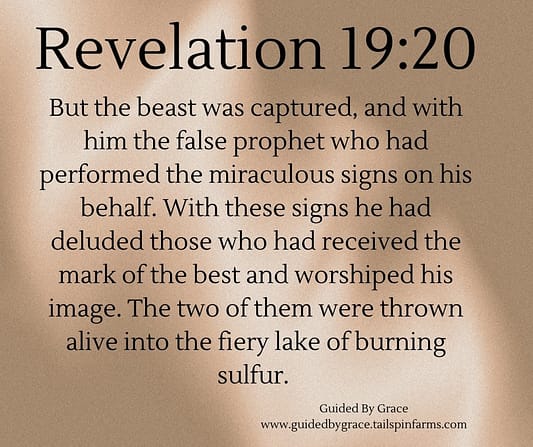
And the beast was taken, and with him the false prophet that wrought miracles before him, with which he deceived them that had received the mark of the beast, and them that worshipped his image. These both were cast alive into a lake of fire burning with brimstone.
FALSE PROPHET … THE MIRACULOUS / REVELATION 19:20
John again describes the false prophet by one primary characteristic: he deceived many by performing miraculous signs (Revelation 13:13-15; 2 Thessalonians 2:9-10). Since Satan can only imitate the genuine things of God, these miracles will be full of lies and deception, just as in all that Satan does (John 8:44). In the last days, those who desire to remain faithful to Christ and His Word (Revelation 14:12) must not base their perception and evaluation of truth and reality solely on the appearance of success or miracles. The Lord Himself warns: “For false Christs and false prophets will appear and perform great signs and miracles to deceive even the elect – it that were possible” (Matthew 24:24).
Some links may be affiliated. By purchasing an item from an affiliate link, I receive a small commission – but you are not charged more or less by clicking or purchasing through the link. Thank you for supporting me!
Some of our Post That Might Interest You, All Out of the Current Book / Chapter
15 But the Lord said unto him, Go thy way: for he is a chosen vessel unto me, to bear my name before the Gentiles, and kings, and the children of Israel:
16 For I will shew him how great things he must suffer for my name’s sake.
SUFFER FOR MY NAME / ACTS 9:15-16
Saul’s (Paul’s) spiritual transformation not only involved a commission to preach the message of Christ, but also a call to suffer for the cause of Christ. In Christ’s kingdom, suffering for His sake is a sign of God’s highest favor (Acts 14:22; Matthew 5:11-12; Romans 8:17; 2 Timothy 2:12). It is often the way to a truly fruitful and effective ministry (John 12:24; 2 Corinthians 1:3-6), and it results in great reward in heaven (Matthew 5:12; 2 Timothy 2:12). A follower of Christ must experience this process of “dying to self” (rejecting and becoming unresponsive to sin and selfish desires) on a daily basis (Romans 6:2-11; 8:10-14; 1 Corinthians 15:31). “Dying to self” allows believers to experience God’s life flowing through them, bringing God’s love and salvation to others (Romans 8:17-18, 36-37; 2 Corinthians 4:10-12).
Some links may be affiliated. By purchasing an item from an affiliate link, I receive a small commission – but you are not charged more or less by clicking or purchasing through the link. Thank you for supporting me!
Some of our Post That Might Interest You, All Out of the Current Book / Chapter
But when they believed Philip preaching the things concerning the kingdom of God, and the name of Jesus Christ, they were baptized, both men and women.
THEY BELIEVED … THE NAME OF JESUS CHRIST / ACTS 8:12
The Samaritans had fully met the conditions for receiving spiritual salvation and were Christians before the Spirit came upon them.
They “believed” and were “baptized” (Acts 2:38). Two facts make it clear that the faith of the Samaritans was genuine saving faith (the kind that gave them a legitimate personal relationship with God).
Both Philip (Acts 8:12) and the apostles (Acts 8:14; 14:4) considered the Samaritans’ faith to be valid.
The Samaritans publicly acknowledged their commitment to Christ by water baptism. Scripture affirms that “whoever believes and is baptized will be saved” (Mark 16:16; Acts 2:38). The baptism did not save them, but it was a means of identifying with Jesus (Romans 6:4) and publicly testifying to their faith in Christ. As a result of that faith, they had been spiritually “born again” (John 3:3-6) and had the Holy spirit living within them (Romans 8:9).
Their receiving the Holy Spirit several days later (Acts 8:17) was not for salvation. It was rather a receiving of the Spirit as the disciples did at Pentecost, to equip them with power to serve Christ and spread His message (Acts 1:8; Acts 2:4). Luke uses the term “receive the Spirit” mainly in an empowering sense (Acts1:8; Acts 2:38; Acts 8:17; Acts 10:47; Acts 19:2), not in the sense of spiritual salvation.
Some have taught that the Samaritans’ faith was not a spiritually saving and renewing faith (the kind that brought them into a personal relationship with Christ). However, it is unreasonable to believe that Philip, a man full of the Holy Spirit and wisdom (Acts 6:3-5), would baptize, heal, and command demons to come out of people whose faith he thought was not genuine.
Some links may be affiliated. By purchasing an item from an affiliate link, I receive a small commission – but you are not charged more or less by clicking or purchasing through the link. Thank you for supporting me!
Some of our Post That Might Interest You, All Out of the Current Book / Chapter
When they heard these things, they held their peace, and glorified God, saying, Then hath God also to the Gentiles granted repentance unto life.
WHEN THEY HEARD THIS / ACTS 11:18
Peter’s speech silenced all objection (Acts 11:4-18). God had baptized the Gentiles (people of other nationalities who were not Jewish) in the Holy Spirit (Acts 10:45) with the convincing evidence of speaking in tongues (Acts 10:46). This was the only sign they needed to accept the Gentiles’ experience as authentic and real without a doubt.
Some links may be affiliated. By purchasing an item from an affiliate link, I receive a small commission – but you are not charged more or less by clicking or purchasing through the link. Thank you for supporting me!
Some of our Post That Might Interest You, All Out of the Current Book / Chapter
And when Paul had laid his hands upon them, the Holy Ghost came on them; and they spake with tongues, and prophesied.
THE HOLY SPIRIT CAME ON THEM / ACTS 19:6
This event occurs about 25 years after the first outpouring of the Holy Spirit at Pentecost (when God generously sent His Spirit to fill and empower His followers, Acts 2:4). Yet, the pattern of these twelve people receiving the fullness of the Holy Spirit is consistent with the pattern seen throughout the book of Acts (Acts 8:5-24).
They had believed in Jesus and were born again by the Spirit (they had been spiritually renewed or “saved” and entered a personal relationship with Jesus).
After they were baptized in water (Acts 19:5), Paul laid his hands on them, and they were baptized in the Holy Spirit.
As the Holy Spirit came on them, they began speaking in tongues and prophesying (using their voice to honor God by inspiration of the Holy Spirit). The book of Acts never presents the outpouring of the Spirit without any outward evidence. Rather, it shows it to be an obvious and identifiable experience that could be verified by the initial physical evidence of speaking in tongues. This practice is a Holy Spirit-inspired way of speaking, praying, or praising God by which a Christian speaks in a language (Greek glossa) they have never learned (Acts 2:4; 1 Corinthians 14:14-15).
Some links may be affiliated. By purchasing an item from an affiliate link, I receive a small commission – but you are not charged more or less by clicking or purchasing through the link. Thank you for supporting me!
Some of our Post That Might Interest You, All Out of the Current Book / Chapter
Acts 10:46 For they heard them speak with tongues, and magnify God. Then answered Peter,
SPEAKING IN TONGUES / ACTS 10:46
Peter and those with him considered speaking in unlearned languages, as inspired by the Holy Spirit, to be the convincing sign of the baptism in the Spirit. Just as God confirmed His actions at Pentecost by the sign of tongues (Acts 2:4), He causes the Gentiles in Cornelius’ house to speak in tongues as a convincing sign to Peter and the other Jewish believers.
Some links may be affiliated. By purchasing an item from an affiliate link, I receive a small commission – but you are not charged more or less by clicking or purchasing through the link. Thank you for supporting me!
Some of our Post That Might Interest You, All Out of the Current Book / Chapter
Websites store cookies to enhance functionality and personalise your experience. You can manage your preferences, but blocking some cookies may impact site performance and services.
Essential cookies enable basic functions and are necessary for the proper function of the website.
Name
Description
Duration
Cookie Preferences
This cookie is used to store the user's cookie consent preferences.
30 days
Statistics cookies collect information anonymously. This information helps us understand how visitors use our website.
Google Analytics is a powerful tool that tracks and analyzes website traffic for informed marketing decisions.
Contains information related to marketing campaigns of the user. These are shared with Google AdWords / Google Ads when the Google Ads and Google Analytics accounts are linked together.
90 days
__utma
ID used to identify users and sessions
2 years after last activity
__utmt
Used to monitor number of Google Analytics server requests
10 minutes
__utmb
Used to distinguish new sessions and visits. This cookie is set when the GA.js javascript library is loaded and there is no existing __utmb cookie. The cookie is updated every time data is sent to the Google Analytics server.
30 minutes after last activity
__utmc
Used only with old Urchin versions of Google Analytics and not with GA.js. Was used to distinguish between new sessions and visits at the end of a session.
End of session (browser)
__utmz
Contains information about the traffic source or campaign that directed user to the website. The cookie is set when the GA.js javascript is loaded and updated when data is sent to the Google Anaytics server
6 months after last activity
__utmv
Contains custom information set by the web developer via the _setCustomVar method in Google Analytics. This cookie is updated every time new data is sent to the Google Analytics server.
2 years after last activity
__utmx
Used to determine whether a user is included in an A / B or Multivariate test.
18 months
_ga
ID used to identify users
2 years
_gali
Used by Google Analytics to determine which links on a page are being clicked
30 seconds
_ga_
ID used to identify users
2 years
_gid
ID used to identify users for 24 hours after last activity
24 hours
_gat
Used to monitor number of Google Analytics server requests when using Google Tag Manager